
righty tighty, lefty loosey
(Designing Controls That Feel Second NAture)
Published Mar 9th
Author Logan Mentjes
At the core of Screwed is a mechanic centered around screwing into and screwing out of objects in the environment. This action drives both traversal and interaction, and it is supported by additional movement options such as rolling, vertical hopping, and flinging yourself across the map like a slingshot. With this solid set of mechanics in place, we made the decision early on to design the game primarily around controller input. While keyboard controls are available, this post focuses on the controller experience, as the game is built with that in mind.
In Screwed, we are experimenting with a control scheme that is mechanically unique to the experience. Because the game is built around unconventional movement and interaction, this approach comes with its own set of challenges, testing, and iteration. Much of our development time has been spent refining these controls to ensure they feel intuitive, comfortable, and satisfying to use so that players can focus on experimenting with puzzle solutions and exploring the environment from a screw’s eye view.
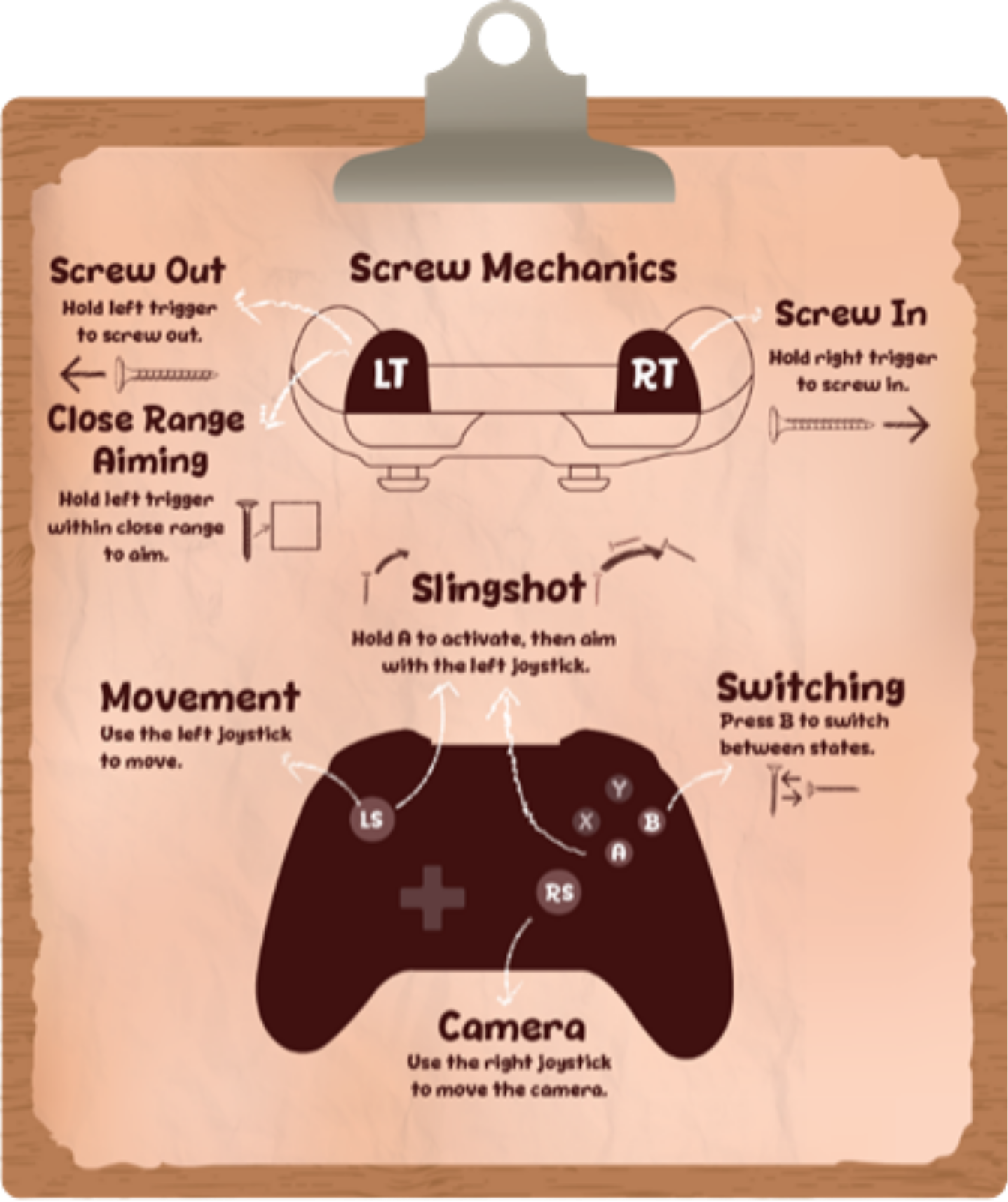
The first challenge we tackled was the screwing in and screwing out mechanic. Because this action is used constantly, it needed to feel natural and intuitive, even when repeated over long play sessions. The phrase “righty tighty, lefty loosey” quickly became a point of reference. Many players already associate this logic with real-world objects like lids, faucets, and screws, so it made sense to mirror that mental model in our controls.
Our initial idea was to use the right joystick as a manual rotation input, turning it right to screw in and left to screw out. While this worked conceptually, testing revealed that the repetitive motion could be uncomfortable and tiring. Additionally, the right stick proved far more valuable when reserved for movement. From there, we decided to keep screwing in on the right side of the controller and screwing out on the left side, preserving the real-world logic without the physical strain.
Once we established the sides, we needed to decide where those inputs should live. The triggers were an early consideration, as they felt natural and symmetrical. However, triggers carry strong associations with aiming and shooting, which we felt were better suited for another mechanic. As a result, screwing in and out were moved to the bumpers.
Figure 2 Final Control Screens
With the main interaction defined, we moved on to movement. Using the right stick for vertical movement felt like a straightforward solution, but we also experimented with tank-style controls for horizontal movement. In practice, players found this approach clunky and often avoided horizontal movement altogether. Based on this feedback, we shifted to basic stick movement for both vertical and horizontal traversal, creating a more fluid and approachable experience.
The final major mechanic we addressed was flinging. This action closely resembles aiming and shooting, making the triggers a natural fit. With that decision in place, the overall control layout came together cleanly: bumpers for screwing, sticks for movement, and triggers for flinging.
Through playtesting, we refined timing, sensitivity, and feel until the controls became second nature. The final scheme supports the game’s unique mechanics while staying intuitive, allowing players to focus on mastering movement and exploration rather than the controller itself. (Maybe change the end a little depending on how the controls end up)
Read More…

