
How Do You Make Everyone’s Grandma’s Kitchen?
Published April 4th
Author Olivia Siegfried
You’re back in that kitchen, the one from your childhood-- yes, the one you remember fondly. The warm light of the Tiffany-styled glass lamp overhead beams down on the playing cards in your small hands, as you sit at the table patiently. Knick-knacks line the shelves, holding memories made long before you were born. The china cabinet is full of delicate teacups you’ve never touched in your life, and probably never will. The smell of a warm, home-cooked meal surrounds you, and you look forward to whatever your Go-Fish opponent is making for dinner tonight.
For me, it was goulash, but not really; consisting of only tomato soup, ground beef, and elbow noodles, any Hungarian would cringe at the sight. But the old woman who used to take care of me as a child called it goulash, so goulash it was.
Many of us have a meal like that, and a kitchen to think back to. So how do you embody that feeling, and how do you translate it to a game?
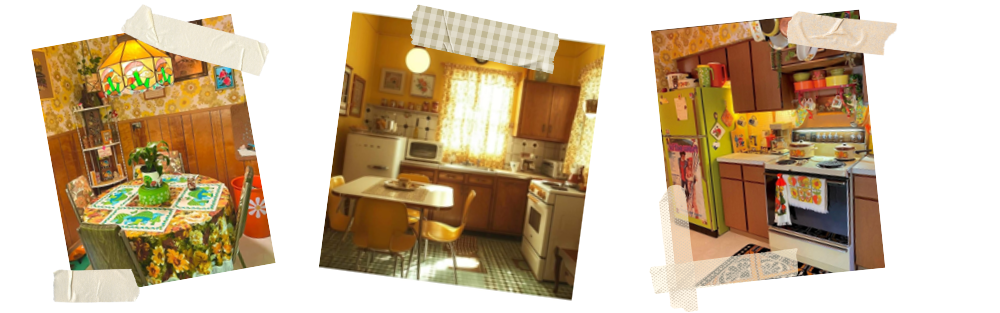
We started by choosing an era. While the majority of our team grew up in the late 2000s & early 2010s, the environments that gave us that feeling of nostalgia were much older. We landed on a wide range-- anywhere from the 1950s for permanent fixtures like the cabinets, all the way up to the 1990s for new things like smaller appliances. A hodge-podge of collected items from the past half-century felt the most authentic, because that’s what humans do, especially average folks that aren’t exactly wealthy. We keep things long after they “go out of style”, so long as they still work or spark joy. We feel sentimental towards objects that have served us well, in whatever purpose they have. By looking at these behaviors, the “if it ain’t broke” values of the people we grew up learning from, we could see how they made their houses into the homes that we so fondly remember.
Following that process ourselves, we asked questions like “If our game takes place in the 90s, what would have lasted from the 60s? What might our character have grown attached to? What could she fix instead of replace?”, we gradually began to understand what the kitchen of our eccentric older lesbian homeowner might look like.
From there, it was Go Time. The big stuff was first up on the modeling checklist, things like large appliances (stove, fridge, etc), counters, and cabinets. We wanted to get our base framework set up as early as possible, in order to be able to cohesively build the rest.

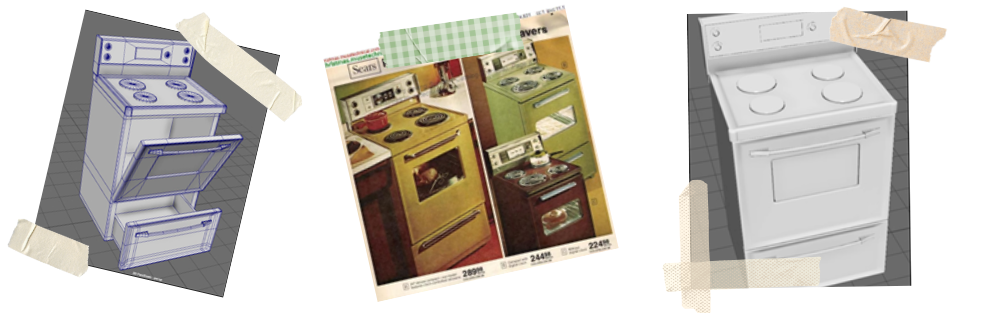
We decided to go with a more realistic style, aiming for higher fidelity with lower poly counts by minimizing unnecessary and nonvisible geometry. This allows us to spend more polys detailing the unique little knick-knacks that give the kitchen personality, along with the props that players will maneuver through the level with. Anything the player will be up close to requires a higher level of fidelity in comparison to background content, especially given the size of our character-- a screw. This is because, of course, a screw sees the world much larger than a human does. To the player, a can of soup is a boulder within the landscape of a kitchen counter. To a person, it is merely something to grab and put in the pantry, without a second thought. The props that fill our world cannot have the same relatively low resolution as the props that fill a game like Skyrim’s world, and that is something we have had in mind every step of the way.
These are just a few of the methods and guiding ideas that have gotten us to the halfway point in the development timeline. Now that the base of our kitchen is built, we can slowly grow it to feel nostalgic to almost everyone, to radiate the warmth and familiarity present in everyone’s grandma’s kitchen.
Read More…

